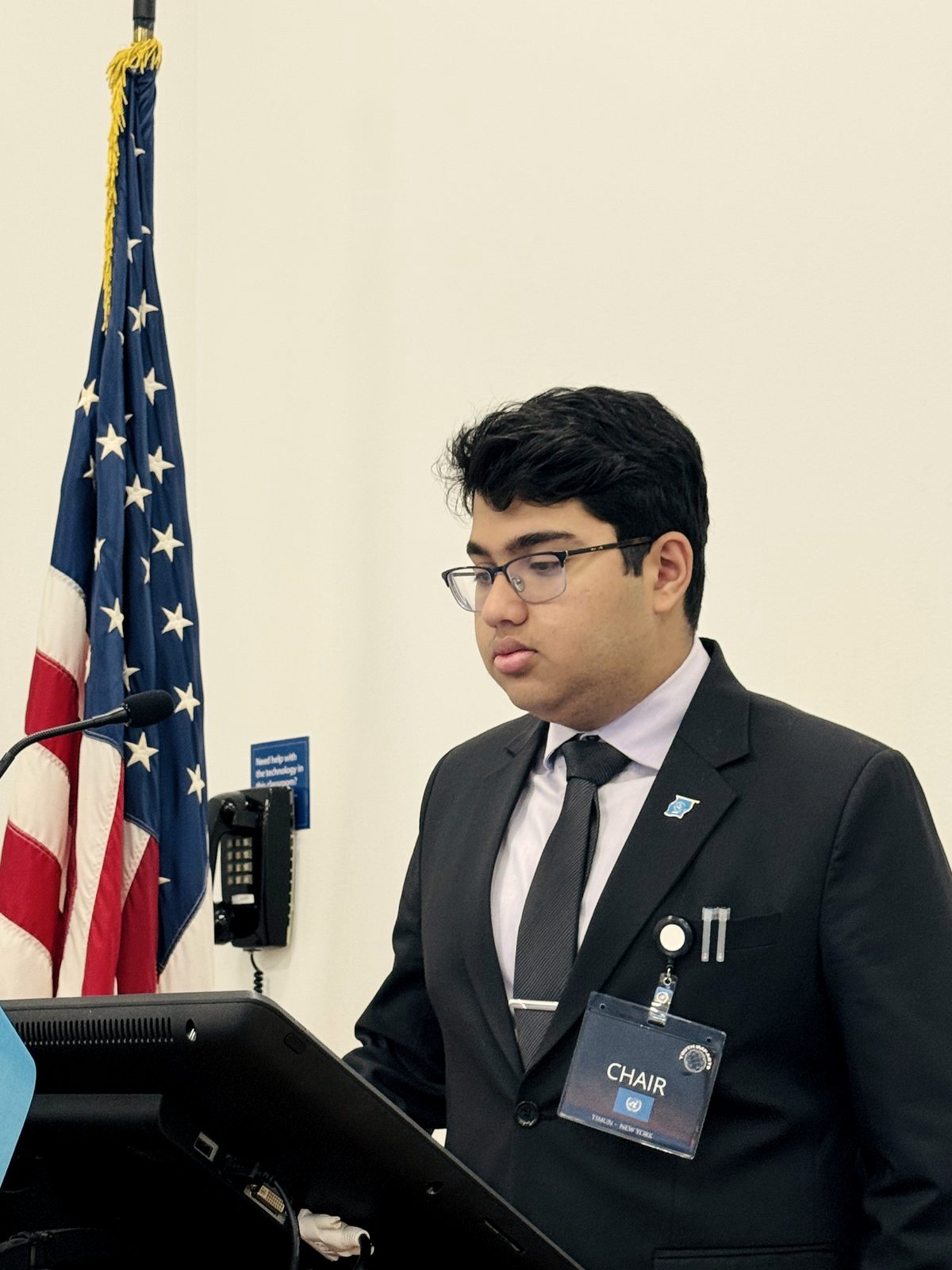
- Write a one-page position paper in diplomatic third-person voice.
- Identify and cite at least five reliable sources, including UN documents and reputable secondary analysis.
- Phrase proposed solutions as scoreable, operative-style clauses with mechanism.
- Recognise the unspoken fourth section every winning paper contains: red lines.
- What a position paper is — and what it isn't
- The standard structure (and the version that wins)
- Diplomatic voice in three sentences
- How to research a country in two hours
- Writing solutions chairs can use
- Formatting and submission
- A worked example, paragraph by paragraph
- Mistakes that quietly kill scores
- FAQ
What a position paper actually is
A position paper is a one- to two-page diplomatic memorandum, written from the perspective of your assigned country, that does three things: outlines the country's understanding of the topic, declares the country's position on it, and proposes the policy directions the country will pursue in committee.
It is not an essay. It is not a research summary. It is a working document: chairs read it, mark it, and reference it during committee to verify whether your speeches and clauses are consistent with the country you said you'd represent.
The structure that wins
Most position paper guides give you a three-part template. They are not wrong, but the template alone is not what wins awards. What wins is treating each section as a different rhetorical job.
Section 1 — Topic background
Goal: prove you understand the issue. One paragraph, eight to ten sentences. Cite the relevant UN resolutions, treaties, working groups and statistics. Avoid editorial language — describe the problem the way a UN report would.
Section 2 — Country position
Goal: show that you understand your country's view of the issue, including its tensions and trade-offs. This is where most papers fail. They restate the topic. The strong ones explain why the country holds its position — economic interests, treaty commitments, regional dynamics, domestic politics — and acknowledge where its position has nuance or has shifted over time.
Section 3 — Proposed solutions
Goal: give the chair something to score on substance. Three to four concrete policy directions, each phrased like an operative clause. Be specific. "Increased international cooperation" is wallpaper. "Establishing a UNDP-administered trust fund of $200m to finance climate adaptation in SIDS, replenished triennially" is a clause.
The hidden 4th section
The strongest position papers add an unstated fourth element: red lines. A sentence or two that signals what your country will not agree to. Chairs notice this. So do the delegates who later approach you in caucus.
Diplomatic voice in three sentences
Position papers are written in the third person, in the voice of the country. Not "I think" — "France believes." Not "we should" — "the Republic of France calls upon member states to."
The tone is restrained. Diplomatic writing prefers regret to "outrage," concern to "alarm," condemn in the strongest possible terms to anything stronger. This is not weakness; it is calibration. Every word in diplomatic English is on a ladder, and signalling where you sit on the ladder matters.
Voice cheat sheet
- Welcomes — supports, in line with policy.
- Notes — acknowledges without endorsing.
- Recalls — reminds the room of an existing commitment, often a binding one.
- Expresses concern about — disagrees, mildly.
- Deplores / strongly condemns — disagrees, sharply.
- Calls upon / urges — recommends action, non-binding.
- Decides / demands — the strongest verbs, used only by Security Council.
How to research a country in two hours
You do not need to read a foreign policy textbook. You need to find five reliable sources and synthesise them.
- UN voting record on the topic — search the UN Digital Library for past resolutions and check how your country voted. This alone usually tells you the position.
- The country's most recent statement to the General Assembly or topic-specific committee — the UN's "GA general debate" archives are searchable by country.
- The country's foreign ministry website — most have a topics page. Read the official line.
- One reputable analysis — Council on Foreign Relations, International Crisis Group, Chatham House, IISS or Carnegie. This gives you the analytical context.
- One news source from the past 12 months — Reuters, AP, BBC, Al Jazeera, Le Monde, AFP. This catches recent shifts.
Two hours, five sources, and you have enough to write a paper that beats 80% of the field.
Writing solutions chairs can use
The solutions section is where Best Position Paper is decided. Two principles.
Be operative-clause-shaped. Write each solution as if it were a numbered paragraph in a resolution. Begin with an active verb — establishes, requests, encourages, decides, urges. The chair should be able to lift your paragraph straight into a working paper.
Be implementable. A real diplomat does not propose abstractions. They propose mechanisms — funds, working groups, monitoring frameworks, reporting cycles, voluntary national reviews. Name the body that does the thing, the source of the funding, and the cadence of review.
Formatting and submission
- One page per topic, single-spaced. Some conferences allow two — check the rules.
- 11 or 12 point Times New Roman, Garamond or Calibri. No decorative fonts.
- Country name and committee at the top. Topic title underneath.
- Footnoted citations or a short bibliography at the end.
- No images, no tables, no flags. The text does the work.
- Submit by the deadline. Late papers are commonly disqualified from Best Position Paper.
A worked example
Below is a one-page position paper, written for a fictional General Assembly committee on Climate-Induced Displacement, representing the Republic of Kiribati. Read it, then re-read it noticing the structural moves: each paragraph does a different job.
Position paper · Republic of Kiribati
Committee: United Nations General Assembly, Plenary
Topic: Addressing Climate-Induced Human Displacement
I. Background. Climate-induced displacement now affects an estimated 21.5 million people each year (UNHCR, 2024). For low-lying small island developing states (SIDS), the question is no longer adaptation but survival of statehood. The 2023 General Assembly resolution A/RES/77/276 recognised the urgency of mobility frameworks for climate-displaced persons; the 2018 Global Compact for Safe, Orderly and Regular Migration laid the groundwork; yet no binding instrument exists. Kiribati's Migration with Dignity policy, launched in 2014, remains a leading model.
II. Position. The Republic of Kiribati believes climate-induced displacement requires a binding international framework that recognises the rights and dignity of climate-displaced persons, preserves the sovereignty and statehood of climate-vulnerable nations, and obliges historical emitters to contribute proportionately to relocation, adaptation and loss-and-damage financing. Kiribati notes with grave concern that current voluntary mechanisms place the burden of climate displacement on the states least responsible for emissions. Recalling A/RES/77/276 and the Paris Agreement Article 8, Kiribati maintains that loss and damage is not aid — it is responsibility.
III. Proposed solutions. Kiribati respectfully proposes that this committee: (1) establish a UNHCR-administered Climate Mobility Framework granting climate-displaced persons recognised legal status and access to labour markets in receiving states, with financing through the existing Loss and Damage Fund; (2) request the Secretary-General to convene a Group of Eminent Experts to draft, by 2028, a binding protocol on the preservation of statehood for territorially endangered states; (3) urge Annex I countries to commit no less than 0.7% of GDP to climate adaptation finance for SIDS, reported triennially through the UNFCCC Voluntary National Review process; and (4) encourage bilateral mobility partnerships modelled on Kiribati's Migration with Dignity programme.
Sources: UNHCR Global Report 2024; UNGA A/RES/77/276; Paris Agreement, Article 8; Kiribati MFAI Climate Policy 2023; CFR briefing "Climate Migration in the Pacific" (2024).
Notice what the example does: it cites real documents, takes a recognisable but defensible national position, lists four operative-shaped solutions, and signals red lines (the rejection of "aid" framing, the insistence on binding instruments). A chair reading this knows they have a serious delegate before they have heard a single speech.
Mistakes that quietly kill scores
- Restating the topic in the country position section. If a reader can't tell whether you are writing for France or for Brazil, you have not written a position paper.
- Vague solutions. "Increased cooperation," "stronger frameworks," "more funding." None of these are scoreable.
- Missing citations. Even one footnote signals seriousness. Five signals scholarship.
- First-person voice. "We believe" turns a memorandum into an essay.
- Ignoring the country's actual record. Chairs check. Writing what the country should believe instead of what it does believe is the fastest way to lose credibility.
FAQ
How long should a position paper be?
One page per topic, single-spaced, in 11-12pt font is the standard. Always confirm the conference's submission guidelines.
Should I send the paper to my chair separately?
No — submit through the official portal or email listed in the conference background guide. Chairs flag delegates who try to send papers privately for a competitive edge.
Can I quote my country's leader directly?
Yes, sparingly. One well-chosen direct quote from a foreign minister or head of state, properly cited, can anchor a position. Three quotes turn a paper into a press release.
What's the difference between a working paper and a position paper?
A position paper is written individually before the conference. A working paper is drafted collaboratively in committee and becomes the basis for a draft resolution.
Practice what you've learned.
The position paper is built by drilling, not by reading. Set aside one focused hour for these exercises — and one more if you intend to win Best Position Paper.
- The 200-word position. Pick a country other than your own. In 200 words, write a country-position paragraph for that country on a topic in today's news — without restating the topic. The reader should be able to identify the country in three sentences.
- Wallpaper audit. Take one of your old papers (or any sample online). Mark every clause that is wallpaper — vague, unactionable, lift-and-paste. Rewrite three of them with specific mechanism.
- The five-source check. Pick a topic. List the five sources you would use, one from each of the categories described in the module: voting record, country GA statement, foreign ministry, reputable analysis, recent news.
- Voice ladder. Take one strong claim — "X must stop Y immediately" — and rewrite it at five increasing temperatures of diplomatic language. Which one would your country actually use?
- The thirty-minute draft. Pick a topic. Set a timer for 30 minutes. Produce a complete first-draft position paper. The artificial constraint is the point — finished beats perfect.