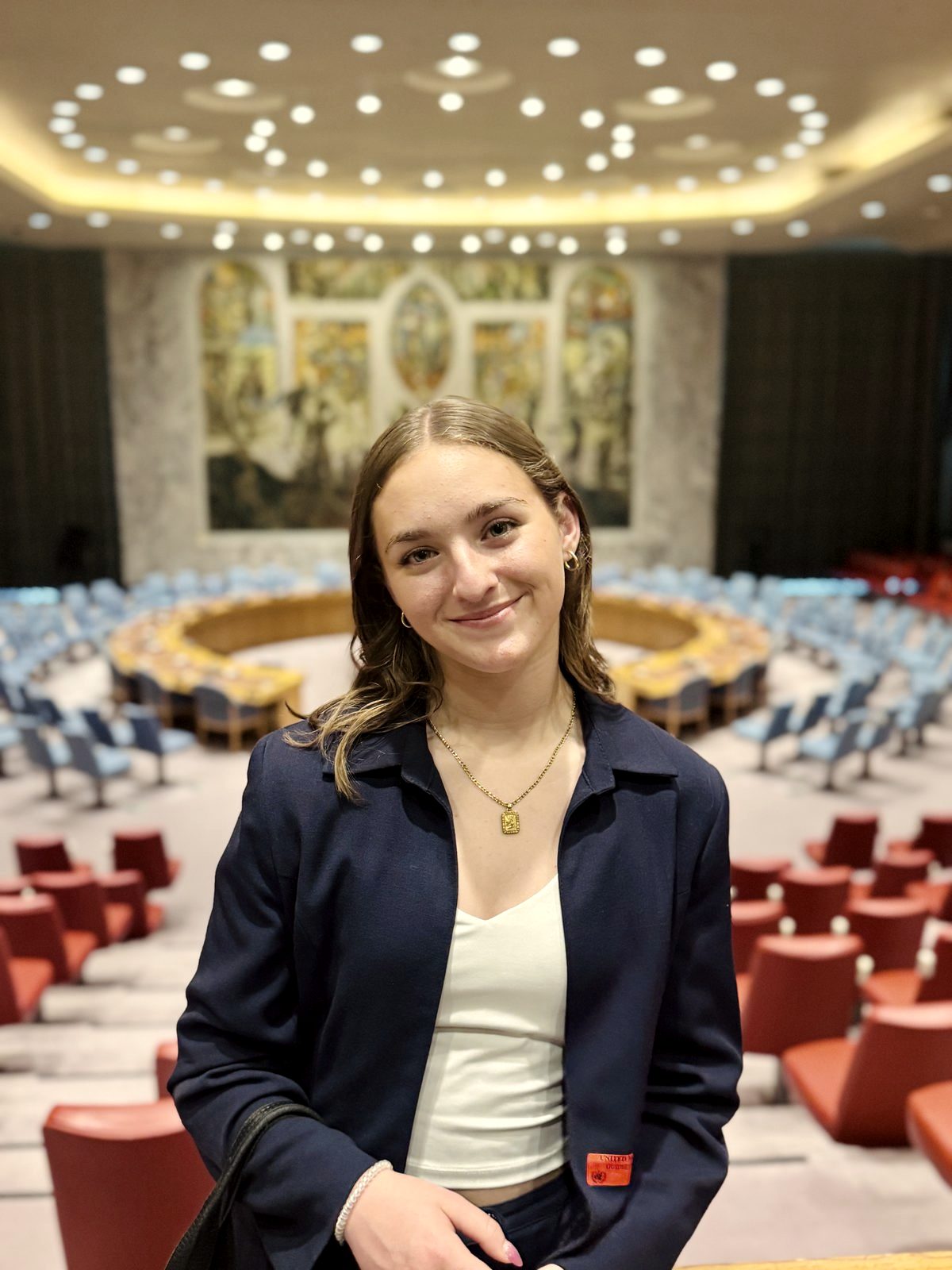
Every year, the conferences get bigger. Six hundred delegates becomes nine hundred; twelve committees becomes twenty. The case for scale is intuitive: more delegates, more revenue, more reputation. We disagree, deliberately. The Global 60 admits sixty delegates and seats all of them in one committee: a simulation of the United Nations General Assembly, one delegate per member state. Here is why.
Key takeaways
- One room, one topic: every delegate debates the same question, so the cohort shares an argument rather than splitting into strangers.
- The General Assembly is the right body to simulate for that. It is the one United Nations organ where every member state sits.
- One dais of four, two chairs and two vice-chairs selected by application, in front of every delegate for every session, with the time to give written and spoken feedback.
- Sixty is small enough that every delegate takes the floor, every bloc needs every vote and the dais knows every name.
- We accept real trade-offs: tightly run sessions, fewer awards in total and a single background guide that has to be excellent.
- No tier of admission changes country assignment, speaking time, committee role, awards or recognition.
The problem scale solves and the one it creates.
A six-hundred-delegate conference solves real problems. It absorbs more applicants, produces more alumni and allows specialised committees that would not fill at smaller scale. None of that is wrong.
But it creates a structural problem nobody likes to name. Twenty committees means twenty topics, twenty rooms and twenty chair teams of varying experience. A delegate meets the people in their own room and almost nobody else. The cohort that gathers for the opening ceremony leaves on Sunday as twenty groups of strangers who happened to share a building.
The scale that lets the conference run is the same scale that stops it being a single experience. We wanted the opposite: one room, one question, one weekend that everybody in it can describe the same way.
One room, one topic.
The Global 60 runs one committee. All sixty delegates sit in the same room, each representing a member state, and debate the same agenda from the first session on the Wednesday afternoon to the final vote on the Thursday afternoon. The agenda is published: Governing Artificial Intelligence: Safeguarding Humanity, Bridging Global Divides, and Shaping Our Shared Future.
That has consequences we like. Every delegate reads the same background guide and writes a position paper on the same question, so every conversation over dinner is a continuation of the debate. Blocs form across the whole cohort, not within a fraction of it. By the second evening a delegate knows where every other country in the room stands, because they have all been arguing about the same thing.
It also means the training is shared. When the dais explains why a working paper failed, every delegate learns from it, because every delegate was party to it.
Why the General Assembly.
If you are going to put sixty delegates in one room, the body you simulate matters. A Security Council of fifteen does not scale. A specialised agency leaves out most of the world. The General Assembly is the one United Nations organ where every member state sits, one vote each, and where the quality of the argument rather than the size of the country decides the outcome.
So The Global 60 is a simulation of the General Assembly: single delegation, one delegate per member state, three committee sessions and a final vote. It is also the body most delegates know least well in practice, because at a large conference the General Assembly committees are the biggest rooms and the hardest to get the floor in. We wanted to run one at a size where that is no longer true. Read more about the format in The Assembly.
One dais of four.
Twenty committees mean twenty chair pairs, which inevitably vary in experience and standards. One committee means one dais: two chairs and two vice-chairs, selected by application, the most experienced chairs we can find, in front of every delegate for every session.
A dais of four for sixty delegates can afford to do the slow work. They read every position paper before debate opens. They keep notes on every speech, not only the memorable ones. And they have the time to give feedback a delegate can take home, in writing and in person, because they are not also running nineteen other rooms. We explain how recognition follows from that in Model UN awards explained.
Sixty is small enough.
Sixty sounds large next to a committee of twenty. It is small next to the several hundred delegates in a General Assembly committee at a flagship conference, and that is the comparison that matters.
At sixty, every delegate takes the floor. Every bloc needs every vote, so nobody is irrelevant to the outcome and nobody can hide behind a larger delegation. The dais knows every name by the end of the first session and every delegate's position by the end of the second. A working paper is negotiated by people who have all actually spoken to each other. That is the room we wanted to build.
One vote, on day two.
On the Thursday afternoon the General Assembly votes once. There are no separate resolutions to reconcile and no second stage to bring them to, because the whole cohort has worked on one text and the whole cohort owns the result.
The outcome is read into the record, the chairs give their closing summary of how the debate moved, and the committee rises. Whatever is adopted, or not adopted, every delegate in the room had a hand in it. We think that is a better ending than a ceremony most delegates only watch.
The trade-offs we accept.
Choosing this design means accepting trade-offs honestly.
- Less floor time per head than a room of twenty. So the sessions are run tightly: a disciplined speakers' list, timed speeches, structured moderated and unmoderated caucuses, and working papers before draft resolutions. Delegates who have only sat in loosely chaired rooms will notice the difference in the first hour.
- Fewer awards in total. One committee carries one set of awards, Best Delegate, Outstanding Delegate, Honourable Mention and Best Position Paper, with the high-school and university tracks recognised separately where necessary, and five Global 60 recognitions read at the gala. Each one means more because there are fewer of them.
- One topic. There is no second committee to prefer, so the background guide has to be excellent and the agenda has to carry two concentrated days of debate. The 2027 agenda, governing artificial intelligence, is published with a delegate study guide.
- We do not run every committee type. No Security Council, no crisis cabinets, no historical bodies. If those are what you want, there are excellent conferences that run them. We are not for everyone and do not pretend otherwise.
- Nothing academic is for sale. Tiers change the room, the transfers, the hospitality and where parents sit at the gala. No tier affects country assignment, speaking time, committee role, awards or recognition.
The thing we don't compromise on.
A delegate who walks out of The Global 60 should be visibly different from the delegate who walked in. They should write a stronger paper, give a stronger speech, know how to lobby a room of sixty, how to merge two competing working papers and how to accept a friendly amendment without losing face. Those are not abstract goals. They are the only goals.
If you have ever sat through a four-hundred-delegate committee and never got the floor, you understand why we built it this way. If you have not, this is what we wish someone had built for us when we first started.
Where to go next.
Read how the three committee sessions and the vote fit into four days in New York, or start with our guide to choosing a Model UN conference if you are weighing formats. When you are ready, the application takes about ten minutes, and there is no interview.
The Youth Impacts team. First published 1 May 2026; revised 7 October 2026 to describe the single General Assembly format of The Global 60.